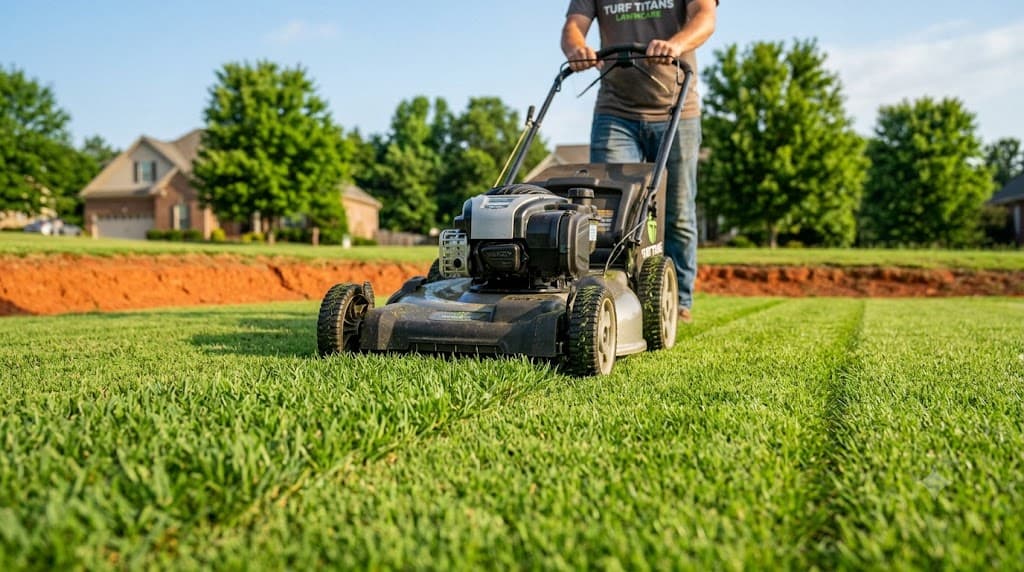
Weekly mowing can actually stress Bermuda and Zoysia. In Huntsville’s summer heat, cutting a little more often—while removing less each time—saves water, keeps color, and chokes out weeds. If you’re wondering how often to mow Bermuda and Zoysia in summer, the answer isn’t “every Saturday.” It’s a flexible rhythm based on growth rate.
Why it matters here: our Zone 7b lawns hit a growth surge by mid‑June, and Huntsville’s clay soil magnifies mistakes. Let grass get too tall between cuts and you’ll scalp high spots, dry the thatch layer, and spend more on water just to recover.
Bottom line up front: in Huntsville summers, mow Bermuda every 3–5 days and Zoysia every 5–7 days at the right height—and adjust with the 1/3 rule after rain, fertilization, and drought. A fixed once‑a‑week schedule is too long for healthy summer growth. If you need local help, see our service area for Huntsville neighbors here: Huntsville, AL.
How often should I mow Bermuda in Huntsville during summer?
For Bermuda, plan on every 3–5 days from mid‑June through August. That window fits Zone 7b’s pace—where growth often accelerates 3–5 days after rain or fertilization—and honors the local rule of thumb: never remove more than one‑third of the blade in a single cut. That one‑third rule is the backbone of growth‑rate scheduling and the clearest answer to how often to mow Bermuda and Zoysia in summer without stressing the turf.
Targets that work on our clay soils:
- Mowing height: 1–1.5 inches with a rotary mower; 0.5–1.25 inches with a reel for hybrid cultivars. On lumpy clay, favor the higher end to avoid scalping crowns on high spots.
- Pass pattern: alternate directions weekly to reduce grain and minor scalping on berms and swales.
- Edges and high‑traffic zones: they grow and dry differently. Give them a touch‑up pass between full mows if they surge.
If your last cut removed more than one‑third—even once—shorten your next interval by a day. Bermuda responds best to lighter, more frequent cuts that keep the canopy dense and the soil shaded.
How often should I mow Zoysia in Huntsville during summer?
Zoysia prefers a slightly slower cadence: every 5–7 days for most of June through August. It’s denser and a tad slower than Bermuda, but in Zone 7b it still ramps up quickly after moisture or nutrients. Keep the 1/3 rule front and center; it’s the simplest way to decide how often to mow Bermuda and Zoysia in summer without causing thatch or sun‑scalded leaf tissue.
Use these Zoysia specifics:
- Mowing height: 1.5–2.5 inches, with 2 inches a reliable North Alabama target for appearance and heat tolerance.
- Cultivar nuance: fine‑bladed varieties can hold a slightly lower height if your surface is smooth; wider‑bladed types look fuller a bit taller.
- Clay‑soil caution: Zoysia crowns can sit just proud of compacted areas. A too‑low deck will “stripe brown” these crowns. If you see straw‑colored lines after mowing, raise the deck 0.25 inch and increase frequency.
Is weekly mowing enough for Bermuda and Zoysia in June–August?
No—weekly is usually too long in Huntsville summers. Here’s the math that trips homeowners up.
- Example for Bermuda at 1.25 inches: If growth averages 0.25 inch per day after a summer rain, by Day 4 the plant has added 1 inch. The 1/3 rule allows you to remove only about 0.4 inch per cut—so you should be mowing again around Day 3–4, not Day 7.
- Example for Zoysia at 2 inches: At 0.15–0.2 inch growth per day, Zoysia adds 0.75–1.4 inches in a week. To stay within 1/3, you’d remove no more than ~0.65 inch, which pushes you toward a 5–6 day rhythm, not a strict seven.
Weekly cuts force you to take too much top growth. That exposes the thatch, bakes the clay, and invites weeds that love sudden light on the soil surface. Shorten the interval and you’ll see thicker turf and steadier color with less water.
What schedule works after rain or fertilizing in Zone 7b?
By mid‑June in Zone 7b, warm‑season lawns often spike in growth about 3–5 days after rainfall or fertilization. Plan around that surge, not the calendar.
Use this simple playbook:
- After a soaking rain or 0.5–0.75 inches of irrigation: plan to mow Bermuda on Day 3–4 and Zoysia on Day 4–5, even if that “breaks” your normal rotation.
- After fertilizing: expect a similar surge. Schedule Bermuda on Day 3–4, Zoysia on Day 5, then resume your usual 3–5 and 5–7 day rhythms.
- If you miss the surge and grass jumps: raise the deck one notch for a catch‑up cut, then come back 2–3 days later at the target height. That two‑step recovery keeps you inside the 1/3 rule and avoids scalping.
Clay‑soil note: rain doesn’t fix compaction. After storms, the top dries fast and the surface turns crusty. That’s when scalping is most likely. Keeping intervals tight and heights conservative protects crowns and keeps moisture in the canopy.
If this sounds like a lot to juggle, Turf Titans builds and manages growth‑rate mowing schedules for homeowners across Huntsville and Madison. See how our mowing service works → Same‑day response. Family‑owned. No contracts.
Should I raise cutting height during drought or heat advisories?
Yes—bump the deck up 0.25–0.5 inch during extended heat or when the county issues heat advisories. Taller leaf area shades the soil, keeps crowns cooler, and reduces water demand.
- Bermuda: If you usually cut at 1.25 inches, go to 1.5–1.75 inches until the heat breaks. Maintain the 3–5 day cadence; frequency matters more than ever because taller grass can hide sudden growth.
- Zoysia: Move from 2 inches to 2.25–2.5 inches. Keep the 5–7 day rhythm. Zoysia tolerates slightly taller mowing well and rewards you with even color.
Two more drought‑smart tweaks:
- Skip mowing during the hottest part of the day. Cutting in peak heat increases tip burn and water loss.
- Never remove more than one‑third of the blade, especially when the plant is water‑stressed. Smaller cuts heal faster and preserve root function in clay soils.
Is it better to bag or mulch clippings for Bermuda and Zoysia?
Mulch most of the time. Finely chopped clippings return nitrogen, reduce surface evaporation, and help buffer our clay soils from sun and foot traffic. When you’re keeping up with frequency, clippings are short enough to filter into the canopy without smothering.
Bag or catch clippings only when:
- You fell behind and would otherwise leave clumps on the surface.
- You see signs of disease and want to remove inoculum.
- You just dethatched or scalped to reset height (rare in midsummer; avoid if you can).
If clumps form, don’t water them in. Re‑mow at a higher deck setting to disperse, or lightly rake so the sun doesn’t bleach the turf beneath.
What time of day is best to mow in North Alabama heat?
Aim for mid‑morning after the dew dries (roughly 8:30–10:30 a.m.) or early evening before dew sets (about 6:30–8:00 p.m.). Those windows give you:
- Cleaner cuts: dry leaf blades shear instead of tear, reducing browning.
- Less stress: you’re avoiding peak heat and direct overhead sun.
- Fewer storms: summer pop‑up thunderstorms often build after lunch. If you mow in the morning, you’re done before gust fronts and sudden showers.
Avoid mowing when the lawn is soggy after a downpour; on clay, wheels rut easily and decks scalp when the soil settles under your weight. If you must mow the same day, wait until the surface is firm and the leaf blades are dry to the touch.
Local takeaway
North Alabama summers reward consistency. For Huntsville’s Bermuda and Zoysia on clay soils, the winning formula is growth‑rate scheduling anchored to the one‑third rule. In practice, that means:
- Bermuda every 3–5 days at summer height.
- Zoysia every 5–7 days at summer height.
- Adjust sooner after rain or fertilization and raise height modestly during heat or drought.
Hold the line on this cadence and your lawn will run cooler, use less water, and keep weeds in the shade. We take a clear stance because it works here: a fixed once‑a‑week schedule is too long for June–August in Zone 7b.
Ready for a schedule that fits your yard, not your calendar? Get a free quote for lawn mowing in Huntsville → /services/lawn-mowing