Homeowners in Madison County hear it all the time: “Add topsoil to fix low spots.” On our clay, that’s the fast track to soggy patches. Counterintuitive but true—dumping topsoil on clay makes drainage worse. Thin layers of washed sand during peak growth level faster without hurting the turf.
In North Alabama, that matters because bumpy lawns don’t just look rough—they scalp under the mower, invite weeds, and hold water after thunderstorms. If you’ve got Bermuda or Zoysia over our dense red clay, the right method and timing protect your grass while you smooth the surface.
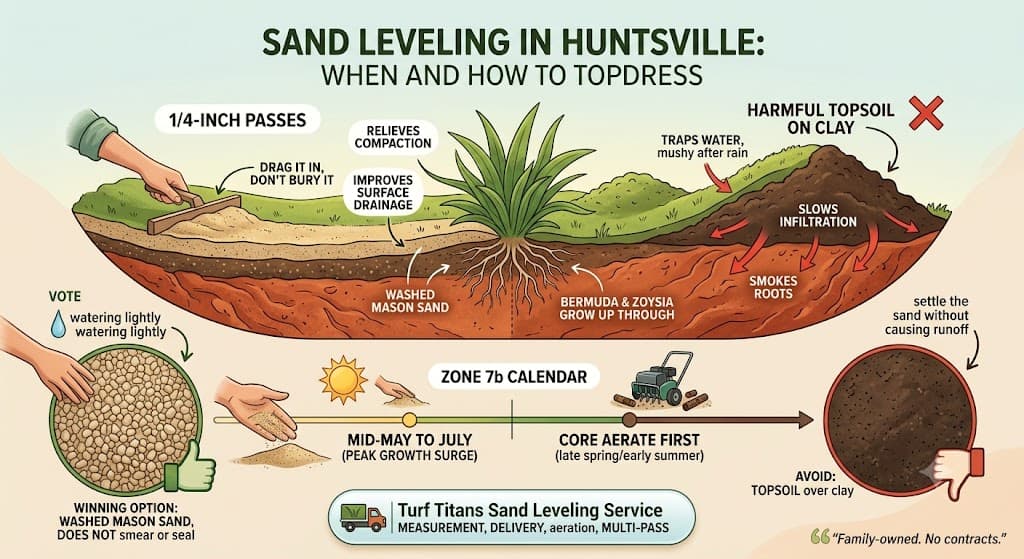
Bottom line up front: for a sand leveling Bermuda lawn or Zoysia in Huntsville, use washed mason sand in repeated 1/4-inch passes from mid-May through July (Zone 7b), ideally after core aeration if the clay is compacted. Drag it in, water to settle, and repeat—skip topsoil.
What is sand leveling and how is it different from topdressing
Leveling is about correcting bumps and shallow depressions so the mower rides smoothly and the turf grows evenly. Topdressing, in the broad sense, is any thin material spread over the lawn—compost, soil, sand—for various goals. On Huntsville’s clay, we use sand topdressing specifically to level, not to add organic matter.
Here’s the key local distinction: when you add a soil layer over clay, the finer particles slow water at the boundary, creating a “bathtub” effect. Washed sand has larger, uniform grains that don’t smear or seal. In light, repeated passes, it fills low micro-spots, improves surface drainage, and lets Bermuda and Zoysia grow up through the layer quickly. If you’re searching for sand leveling Bermuda lawn tips, remember: small, frequent sand passes reshape the surface without burying the grass.
When is the best time to level Bermuda and Zoysia in Zone 7b
In Zone 7b, the prime sand-leveling window is mid-May through July, once soil temperatures are reliably above about 70°F. That’s when Bermuda and Zoysia are pushing new stolons and rhizomes—exactly the growth you want after a leveling pass. Avoid dressing before full green-up and stop as early fall approaches so the lawn can harden off before cooler nights.
This timing also fits our weather rhythm. Early-summer flushes of growth help the turf recover quickly, while scattered storms give just enough moisture to knit the sand into the canopy—without the extended wet periods we see in late fall.
Should you use sand or topsoil for low spots in Huntsville clay
Use washed sand for general leveling on clay. Topsoil over clay often traps water and stays mushy after rains, especially in shaded or low-traffic pockets. Clay’s small particles and high density do not pair well with a looser, organic top layer; the interface slows infiltration and creates soft, scalpy spots.
For isolated deep holes (over 1–2 inches), rebuild in lifts: prefill most of the depth with a sand-heavy mix, tamp lightly, then cap the final 1/2 inch with washed sand so the surface behaves consistently with the rest of the yard. Even in those repairs, keep each lift thin and allow regrowth between applications.
How much sand per 1000 sq ft and how many passes
Think in 1/4-inch passes. A single 1/4-inch layer takes about 0.8 cubic yard per 1,000 square feet (20.8 cubic feet). That’s your baseline.
- Light smoothing: 1–2 passes total (0.8–1.6 cu yd/1,000 sq ft) across the early-summer window.
- Moderate bumps and mower scalp: 2–3 passes (1.6–2.4 cu yd/1,000 sq ft).
- Heavily rutted areas: plan 3+ passes over multiple seasons rather than burying turf.
Never bury more than 1/2 inch at once. For example, a 5,000 sq ft Bermuda lawn usually needs 4–10 cubic yards total in a season, split into two or three 1/4-inch dressings, 3–4 weeks apart. This is the safest way to sand leveling Bermuda lawn areas without thinning grass.
If this sounds like a lot to move and time just right, Turf Titans handles measuring, material, aeration, and multi-pass sand leveling for homeowners across Huntsville and Madison. See what we handle → Same-day response. No contracts.
What type of sand is best for leveling a lawn
Choose washed mason sand from a reputable local supplier. You want clean, uniformly graded, medium-to-fine grains that are angular enough to interlock yet not powdery. Hallmarks of good sand for leveling:
- Washed and low in silt or clay (no cloudiness when you rinse a handful).
- Consistent particle size—no big pebbles, no dust.
- Dry or kiln-dried if you’ll be spreading with a drop spreader.
Avoid play sand (too fine and round; it compacts and seals) and “river sand” that often includes silt. Concrete sand can work in a pinch but is coarser; it’s better for deep-fill layers under the surface than for the final leveling pass. For a premium option, USGA-style sands perform beautifully, but clean mason sand is the sweet spot for most Huntsville lawns.
Do you need to core aerate before sand leveling on compacted clay
If your yard has the typical North Alabama clay—foot traffic paths, mower ruts, or pooling after storms—core aeration is your best friend before leveling. The local rule of thumb is to core aerate Bermuda and Zoysia in late spring to early summer, while they’re actively growing, to relieve compaction and open channels for air and water. That timing dovetails perfectly with your first 1/4-inch sand pass.
Aeration does three big things on clay: it reduces surface sealing, gives sand a place to settle into the profile (not just sit on top), and speeds recovery because roots chase the cores. Aerate 1–2 weeks before you level, or the same day if you have pro equipment that pulls clean, deep cores. Mark irrigation heads and shallow wires first.
How to drag, water, and care for the lawn after topdressing
Spreading and dragging
- Spread sand evenly with a broadcast or drop spreader for thin passes, or shovel and fan it for spot lows.
- Use a level-lute, landscape rake, or a steel drag mat to pull sand across high spots into lows. Work in multiple directions.
- For Bermuda early in the window, a light scalp helps sand sit in the canopy; for Zoysia, lower the mower one notch but avoid a severe scalp.
Watering and settling
- Water lightly right after spreading—just enough to settle the sand without causing runoff. If footprints still sink the next day, you can drag once more to finish.
- After thunderstorms, check for wash lines on slopes and re-pull sand from highs into lows.
Mowing and feeding
- Resume mowing when you can see green leaf tips across the lawn—typically 5–7 days. Mow a notch higher for the first cut, with sharp blades.
- A light nitrogen feeding (0.5 lb N/1,000 sq ft) after each pass helps Bermuda and Zoysia grow through the sand. Hold off on pre-emergent herbicides until after your leveling window; they can slow stolon spread.
Care between passes
- Wait 3–4 weeks between 1/4-inch passes. If areas still feel spongy, hold off and address drainage or compaction first.
- On clay, keep foot traffic off newly dressed sections for several days so you don’t create new ruts.
When should you hire a pro instead of DIY sand leveling
DIY works for small, relatively smooth lawns and a single 1/4-inch pass. Bring in a pro when:
- You need more than 5–8 cubic yards of sand in a season.
- The lawn is very bumpy, sloped, or has irrigation and lighting to protect.
- Clay is severely compacted and needs coordinated aeration plus multi-pass leveling.
- You’re not set up to move and drag material quickly during the short Zone 7b window.
A local crew will measure accurately, source the right sand, schedule passes when soil temps and weather are ideal, core aerate the clay, and protect heads and valves while they drag. If you’re weighing DIY vs help, start with an on-site assessment. Learn how our team approaches it here: sand leveling service.
Local takeaway
On North Alabama clay, the fastest, safest way to smooth Bermuda and Zoysia isn’t topsoil—it’s washed mason sand in repeated 1/4-inch passes, scheduled for peak growth. In Zone 7b, that’s mid-May through July once soil temps crest 70°F. Core aerate compacted areas first, drag the sand across highs into lows, water to settle, then let the grass do what it does best: grow through and lock in a flatter surface.
We stand firmly on this: for our clay lawns, washed mason sand—applied in thin, repeatable layers—is the best method to level Bermuda and Zoysia. If you want eyes on your yard and a plan that fits your exact microclimate and slope, schedule a local visit: Get a free quote for sand leveling in Huntsville →