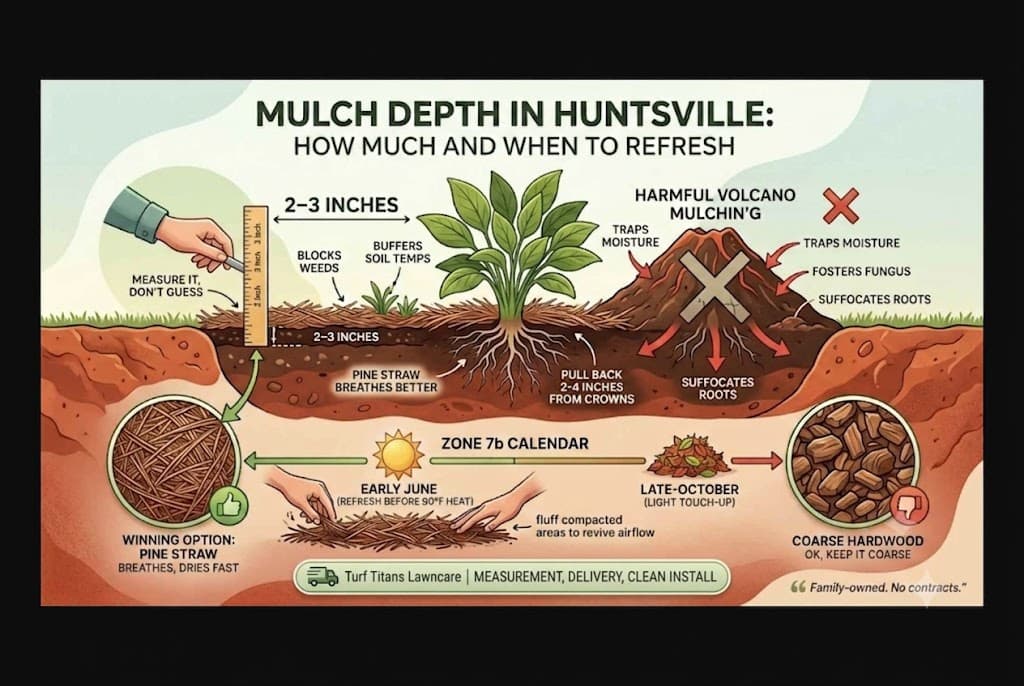
More mulch isn’t better—anything over 3 inches can trap moisture, foster fungus, and suffocate roots in humid North Alabama summers. That runs counter to what many homeowners do: keep stacking mulch every spring until beds look like sponge cakes. In our heat and clay-heavy soils, that habit backfires.
If you garden in Huntsville or Madison, mulch depth isn’t just a cosmetic choice; it affects plant health, water bills, and how often you’re out there pulling weeds. Our clay holds water, our summers turn steamy, and afternoon downpours can flip a “tidy” bed into a fungal mess overnight.
Here’s the quick answer to how deep should mulch be in flower beds: maintain a true 2–3 inch layer, keep it pulled back from trunks and crowns, and time light refreshes to Huntsville’s Zone 7b rhythm—early June before sustained 90°F heat, and a light touch-up after late-October leaf drop.
How deep should mulch be in flower beds in Huntsville?
Aim for 2–3 inches—measured, not guessed. Less than 2 inches won’t block enough light to slow weeds or buffer soil temperatures. More than 3 inches in our humidity can seal the surface, keep crowns too wet, and starve roots of oxygen, especially in compacted clay.
Depth is not one-size-fits-all across the bed. Around shallow-rooted perennials and newly planted shrubs, keep the upper end of that range to help with moisture swings, but feather it thinner (closer to 2 inches) right at plant crowns so they can breathe. In shadier, slower-drying corners, err toward the lower end to avoid soggy pockets. On sunny edges that cook in July, a measured 3 inches is fine—as long as the bed drains and you’re not burying the plant bases.
If you’re reworking your beds or starting fresh, our mulching service installs the correct depth, grades away from trunks, and sets clean edges so rainfall stays where plants need it. See what’s included in our mulching service.
Is pine straw or hardwood mulch better for North Alabama?
For most Huntsville shrub and perennial beds, a 2–3 inch layer of pine straw outperforms hardwood mulch through our humid summers. That’s our firm stance, and here’s why:
- It breathes. Long-needle pine straw knits together but still allows air exchange, so crowns and upper root zones don’t stay wet after pop-up storms.
- It dries faster after rain. Shredded hardwood can mat and form a crust; straw sheds water while letting the top inch dry between rains, reducing fungus pressure.
- It’s easier to top up without over-thickening. A light June refresh with a couple of needles’ thickness extends protection without creeping past 3 inches.
Hardwood still has its place. Coarse nuggets can stay put on steeper slopes and high-traffic areas where straw might shift. If you prefer the look of hardwood, keep it truly coarse to avoid crusting, and be disciplined about total thickness. In either case—straw or wood—the sweet spot in Huntsville remains 2–3 inches.
When should I refresh mulch in Zone 7b?
Work with our local calendar. In Huntsville’s Zone 7b, top up mulch in early June—right before stretches of 90°F days ramp up soil temperatures. A light refresh after late-October leaf drop sets the bed for winter, buffers freeze-thaw, and keeps spring weeds from getting an early start.
Use this local rule of thumb: maintain a 2–3 inch layer of organic mulch, and keep it pulled back a few inches from tree trunks and shrub bases to prevent decay and pest issues. If you measure and find less than about 1.5 inches in spots, add enough to return to the target range. If you’re already at 2–3 inches, “fluff” compacted areas (especially matted hardwood) instead of adding bulk. That revives airflow without raising depth.
How much mulch do I need per 100 square feet?
Here’s the quick math you can trust:
- Formula: cubic feet = (area in sq ft × depth in inches) ÷ 12
- Convert to cubic yards when ordering bulk: cubic yards = cubic feet ÷ 27
For a 100 sq ft bed:
- At 2 inches: 100 × 2 ÷ 12 = 16.7 cu ft ≈ 0.62 cubic yards
- 2‑cu‑ft bags: about 9 bags
- 3‑cu‑ft bags: about 6 bags
- At 3 inches: 100 × 3 ÷ 12 = 25.0 cu ft ≈ 0.93 cubic yards
- 2‑cu‑ft bags: about 13 bags
- 3‑cu‑ft bags: about 9 bags
Two pro tips:
- Measure your current depth first. If you’re sitting at 1.5 inches and want 2.5 inches, you only need to add 1 inch—not the whole amount.
- Order a little extra (5–10%) for bed edges, tree rings, and natural settling.
If this sounds like a lot to juggle, Turf Titans handles measurement, delivery, and clean installation for homeowners across Huntsville and Madison. Get mulch installed right → Same-day response. Family-owned. No contracts.
Should mulch touch shrubs or tree trunks?
Never. Think donut, not volcano.
- Trees: expose the root flare and keep mulch 6–12 inches back from the trunk for young trees; 12–18 inches for mature ones. This reduces rot, bark decay, voles, and borer pressure.
- Shrubs and perennials: stop 2–4 inches short of stems and crowns. In our humidity, even a thin collar of mulch against bark can stay wet long enough to let fungi move in.
Resist the urge to “hide” girdling roots or uneven grades with more mulch. If water is pooling, address drainage and compaction—common in our clay—before you add anything.
Will thicker mulch stop weeds better in clay soil — and how deep should mulch be in flower beds?
Up to 3 inches, yes—weed pressure drops as depth rises. Beyond 3 inches, returns flatten while risks climb in our climate and soil. In North Alabama clay, an over-thick layer holds water like a sponge and blocks oxygen. You’ll trade fewer weeds for stressed roots, fungus, and bark issues.
A better weed plan:
- Hold the line at 2–3 inches across the bed.
- Edge cleanly so Bermuda or other lawn grasses don’t creep in.
- Hand-pull invaders early (small weeds are fast work).
- Skip plastic or tight landscape fabric under organic mulch; they trap water on top of clay and force roots upward.
If a section is chronically weedy, it’s usually light gaps or edge breaches—fix the cause, don’t bury it deeper.
What’s the best way to top up mulch without smothering roots — and how deep should mulch be in flower beds?
Use this four-step refresh that respects plant crowns and our climate:
-
Rake and reset. Loosen matted areas (especially shredded hardwood) to break crusts. With pine straw, lift and re-knit the existing layer; you’ll be surprised how much life it has left.
-
Measure reality. Use a ruler at 6–8 random spots per 100 sq ft. Note the thinnest areas—that’s where you’ll add. Target the same 2–3 inch finished depth across the bed, feathered thinner (closer to 2 inches) within a few inches of stems.
-
Add deliberately. For pine straw, shake in a light, even layer—often just a half-inch is plenty in June. For hardwood, broadcast loosely and avoid packing. Do not bury trunk flares or perennial crowns.
-
Settle smart. Water lightly to seat the mulch and reduce blow-off, then re-check depth at a couple of points. If a spot crept over 3 inches, pull it back now rather than fighting fungus later.
Local note for Zone 7b: time the bigger of your two annual touch-ups for early June—right before those sticky, 90°F stretches begin—so beds moderate midday heat without staying soggy. A second, lighter pass after late-October leaf drop keeps soil insulated through winter and thwarts early spring weeds.
Local takeaway
In Huntsville’s heat, humidity, and clay soils, the winning formula is simple and disciplined: keep mulch at a measured 2–3 inches, never against trunks, and refresh on a Zone 7b schedule. Our clear stance stands: for most shrub and perennial beds, pine straw in that 2–3 inch range outperforms hardwood through our summers by breathing better, drying faster, and resisting matting.
Ready to dial in your beds for North Alabama’s climate? See service details, timing, and what we include with professional installs on our mulching service. Or, if you’d like local help tailored to your neighborhood, get a specific quote here: Get a free quote for mulching in Huntsville →