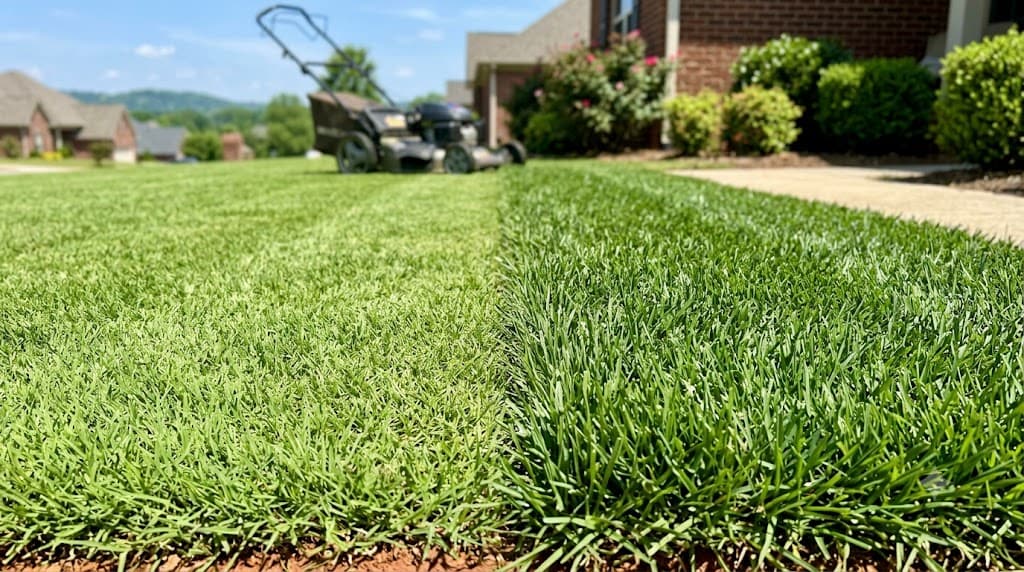
Cutting Bermuda lower in summer doesn’t save time—it costs you turf. In North Alabama heat, mowing too low thins the stand and invites weeds and drought stress. If you’re aiming for the best mowing height for Bermuda and Zoysia, the trick is to set the deck right and mow more often, not lower.
Why it matters here: Huntsville lawns sit on dense clay that bakes and cracks by July. In Zone 7b, warm‑season grasses hit peak growth by June, so they can easily outpace a once‑a‑week cut. Keep the canopy high enough to shade that clay and steady enough to avoid scalping on bumps.
Bottom line for summer (June–August): keep Bermuda at 1–1.5 inches and Zoysia at 1.5–2 inches, mow 2–3 times per week as growth demands, and return clippings. That’s the simple, durable formula for a thick lawn on Huntsville clay.
What is the ideal mowing height for Bermuda in summer?: the best mowing height for Bermuda and Zoysia, explained
For June through August in Huntsville, set Bermuda at 1–1.5 inches—period. That’s low enough to keep a dense, athletic look but high enough to protect stolons from heat and uneven ground. Dip below 1 inch and you’ll expose soil, thin the canopy, and spend the rest of summer fighting crabgrass and hardpan stress.
Use the one‑third rule every time you mow: never remove more than a third of the blade in a single pass. Around here, that means if your Bermuda is at 1.5 inches, don’t let it climb past about 2.25 inches before mowing again. In peak growth, that can be every 2–3 days. A sharp rotary mower is perfectly fine at this height; most home lawns on clay aren’t level enough for ultra‑low reel mowing without scalps.
Quick calibration tip: measure from driveway to blade—not the deck shell—to confirm you’re truly at 1–1.5 inches.
How tall should Zoysia be cut in Zone 7b?: dialing in the best mowing height for Bermuda and Zoysia
Keep Zoysia at 1.5–2 inches during active summer growth. Zoysia is naturally denser and often grows more slowly vertically than Bermuda, but it still benefits from a steady, moderate height in Huntsville heat. At 1.5–2 inches, you preserve enough leaf to photosynthesize through hot afternoons while maintaining a tight, carpeted look.
Shade or mixed‑sun areas? Favor the upper end—closer to 2 inches—to help Zoysia handle filtered light and reduce stress on clay soil that stays wet after storms and then hardens quickly.
How often should I mow from June to August in Huntsville?
By June in Zone 7b, warm‑season grasses are in peak growth. Expect to mow 2–3 times per week to maintain 1–2 inch targets without breaking the one‑third rule. Frequency varies with rain, irrigation, and fertilizer, but your schedule should flex around growth, not the calendar.
A practical rhythm:
- Bermuda at 1–1.5 inches: every 2–3 days in wet weeks; every 3–4 days in dry stretches.
- Zoysia at 1.5–2 inches: every 3–4 days; slow a bit if growth tapers in late summer.
- Tall Fescue patches: if you have them, raise the deck to 3–4 inches for those areas; don’t force cool‑season grass to match Bermuda/Zoysia heights.
Time of day matters. Mow in the evening or mid‑morning after dew dries. Midday cuts in full sun stress leaf tissue, especially on clay that’s already warm.
If this sounds like a lot to juggle, Turf Titans handles weekly scheduling, height tuning, sharp blades, and clean edges for homeowners across Huntsville and Madison. See our lawn mowing service → Same‑day response. Family‑owned. No contracts.
Should I mulch or bag clippings on Bermuda and Zoysia?
Mulch—and make it a habit. Returning clippings recycles nutrients, shields the soil surface, and moderates clay’s temperature swings. Short, frequent cuts produce fine clippings that sift down into the canopy instead of smothering it.
Bag only when:
- You’ve exceeded the one‑third rule and clippings mat on top.
- The lawn is wet and clumps form.
- You’re managing disease and don’t want to spread infected tissue.
Otherwise, mulching supports exactly what we need in Huntsville: steady cover over clay and a bit more moisture retention between summer showers. For a set‑and‑forget approach, a mulching mower maintained through our lawn mowing service keeps the flow right.
Does clay soil change the best mowing height for my lawn?
Yes—clay rewards slightly higher, steadier mowing. Dense clay amplifies scalping on high spots and dries into hardpan during heat waves. To protect the stand:
- Aim toward the upper end of each range: Bermuda 1.25–1.5 inches, Zoysia 1.75–2 inches.
- Mow slower with slight overlap to avoid bouncing over bumps that nick stolons.
- Keep tires off the same tracks; repeated passes create ruts in soft, wet clay after storms.
Long term, level and aerate during the off‑season to reduce scalps—but don’t chase a “golf‑green” cut on home lawns over clay. The soil simply doesn’t forgive mistakes at ultra‑low heights.
What height should I use during drought or heat waves?
When temps spike or rain stalls, raise the deck by 0.25–0.5 inch within your range:
- Bermuda: bump from 1.25 to 1.5 inches, or from 1.0 to 1.25 if you’re on the low end.
- Zoysia: bump from 1.5 to 1.75–2 inches.
Keep mulching. Taller leaf area shades the soil and slows moisture loss from clay. Space out mowings a bit so you’re not cutting heat‑stressed blades too often, but still respect the one‑third rule. If the lawn stalls, hold the height and wait—don’t drop the deck to “clean it up.” Lowering height during stress invites weeds through thin spots.
How sharp should mower blades be for clean cuts?
Sharp blades are non‑negotiable at these heights. Ragged tips dry out faster, look gray, and make Huntsville clay look harsher than it is.
- Inspect after every 4–5 mows; sharpen every 20–25 mowing hours (about monthly if you’re cutting 2–3 times a week).
- A clean cut feels like slicing paper; if you see frayed tips within a day, it’s time to sharpen.
- Level the deck annually. A 1/8‑inch tilt side‑to‑side is enough to scalp high spots on clay.
- Reel vs. rotary: reels can be superb at low heights on extremely level turf, but most home lawns here are better served by a sharp rotary at the recommended summer heights.
Local takeaway
Huntsville’s clay and Zone 7b growth curve call for a simple, disciplined plan: Bermuda at 1–1.5 inches, Zoysia at 1.5–2 inches, frequent mowing that never removes more than a third, and mulched clippings. Don’t chase ultra‑low cuts in summer; they thin the stand and make clay’s extremes worse. Hold the line on height, mow often, and your lawn stays dense, cool, and weed‑resistant.
That’s our stance, and it works on real North Alabama lawns. Ready for a crew that sets heights right and keeps the schedule tight? Get a free quote for lawn mowing in Huntsville → /locations/huntsville-al