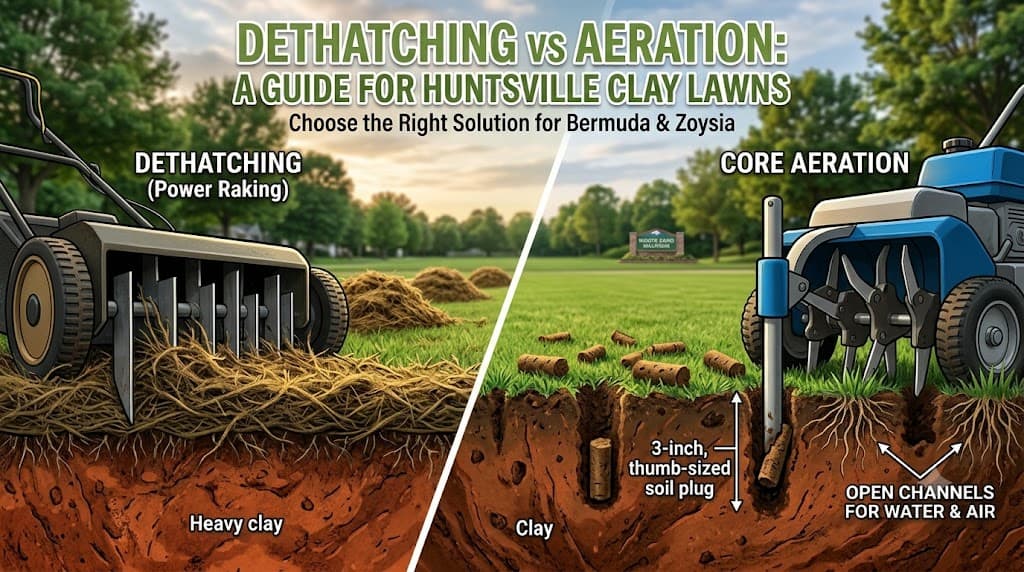
Most Huntsville lawns don’t need a dethatcher at all—clay compaction is the real culprit, and core aeration outperforms power rakes here. If you’ve been wondering whether to dethatch or aerate a Bermuda lawn, the short answer in our area is: choose core aeration.
Why it matters locally: North Alabama’s heavy clay and summer downpours press soil particles tight, starving roots of air and pushing water to run off rather than soak in. That leaves Bermuda and Zoysia thin on the edges, hard underfoot, and slow to green evenly. Power rakes scrape the surface; they don’t open the soil.
Bottom line up front: For Huntsville clay lawns, skip mechanical dethatching for Bermuda and Zoysia and schedule core aeration in early summer. Dethatching only makes sense when you prove there’s a true thatch layer over 0.5 inches thick—which is uncommon here.
What’s the difference between dethatching and core aeration—especially when deciding whether to dethatch or aerate a Bermuda lawn?
Dethatching (often called power raking or verticutting) uses blades to slice and lift the brown, fibrous layer that can build up between green grass and the soil. It’s aggressive by design. On runners like Bermuda and Zoysia, those blades can rip stolons and rhizomes, scarring the lawn and slowing recovery—especially in our sun-baked clay.
Core aeration removes thumb-sized plugs of soil and thatch from the lawn. Those open channels let oxygen, water, and nutrients reach roots, and they relieve the “brick effect” you feel underfoot in Huntsville clay. As the plugs crumble, soil microbes work on the organic material that remains, which naturally reduces minor thatch over time. In other words: dethatching attacks the symptom; aeration fixes the cause.
How can I tell if my lawn has thatch or clay compaction—and should I dethatch or aerate a Bermuda lawn?
Use a 5-minute field check:
- The footstep test: Walk your yard after a normal watering. If it’s hard like a driveway and footprints barely register, think compaction. If it feels bouncy or spongy, that can be thatch.
- The screwdriver test: After a rainfall or a 15–20 minute soak, push a 6–8" screwdriver into the soil. If you need two hands to force it, you’re dealing with compacted clay. If it slides in easily but the surface still feels springy, thatch might be present.
- The thatch check: Cut a small wedge (3" deep) with a trowel. Look for a distinct brown, fibrous layer between green shoots and soil. Under 0.5" is normal. Over 0.5" is true thatch.
Diagnosis in Huntsville clay usually points to compaction. If you’re deciding whether to dethatch or aerate a Bermuda lawn and your wedge shows little to no thatch but the screwdriver stalls, choose core aeration. If you do see over 0.5" of thatch, start with aeration anyway, then correct the habits that created it (see below). Reserve mechanical dethatching for the rare, severe cases—and only when the lawn is fully actively growing and you’re ready for recovery care.
If this sounds like a lot, Turf Titans handles soil testing, timing, and deep core aeration for homeowners across Huntsville and Madison. See how aeration works → (/services/lawn-aeration) Same‑day response. Family‑owned. No contracts.
Do Bermuda and Zoysia in Huntsville actually develop thatch?
Not usually—at least not the kind that needs a power rake. In our hot summers, mulched clippings from Bermuda and Zoysia break down quickly. What looks like “thatch” after a mow is often just dry clippings resting on top; they’ll sift down and decompose within days.
Real thatch buildup in North Alabama tends to come from a few correctable habits:
- Too much quick‑release nitrogen, which can push excessive stem growth faster than microbes can decompose it.
- Chronically high mowing heights on Bermuda, which shade the soil and encourage more stem than leaf.
- Over‑watering that keeps the surface damp but doesn’t penetrate, discouraging microbial activity.
- Layering mismatched topdressing sands over clay, creating a perched layer that traps moisture near the surface.
Zoysia is a bit more thatch‑prone than Bermuda, but on our clay soils, compaction is still the bigger limitation. Address the soil first with core aeration and better cultural habits; thatch usually follows suit.
When should I aerate a warm-season lawn in Zone 7b?
Here’s the Zone 7b playbook: aerate in late May through June after full green‑up, and avoid fall aeration for Bermuda and Zoysia so recovery is quick and weeds don’t exploit open holes. In North Alabama, the local rule of thumb is to core aerate while the grass is actively growing so it can heal rapidly after coring.
Practical timing cues:
- Wait until the lawn is uniformly green and growing (after spring scalping recovery).
- Target a window when daytime highs are in the 80s and nights are consistently warm.
- Water lightly the day before to soften clay; that helps achieve 2.5–3" core depth.
- Skip aeration within 48 hours of a heavy storm—clay smeared by wet tines can glaze shut again.
If you’re planning improvements like compost topdressing, do them immediately after aeration while those channels are open. That’s the moment to turn Huntsville clay into something roots can actually breathe in. For a professional pass that hits the right depth and hole count, see lawn aeration service details here: Lawn Aeration.
Is power raking safe for Bermuda or Zoysia in North Alabama?
Our stance: skip mechanical dethatching for Bermuda and Zoysia here. Power rakes and verticutters can scalp stolons, yank runners from our dense clay, and open wounds that invite summer weeds. Recovery is slower on compacted subsoil, and you can easily trade a cosmetic thatch issue for thin, bare lines across the yard.
If you truly confirm more than 0.5" of thatch and the lawn is otherwise vigorous, a very light, expert‑level verticut can be done—but that’s the exception. For homeowners, core aeration paired with better mowing, watering, and fertilization solves 90% of what people call “thatch” without the collateral damage.
Will aeration help drainage and root growth in clay soil?
Yes—and noticeably so in Huntsville clay. Core aeration:
- Creates vertical channels that increase infiltration during our summer thunderstorms, reducing runoff and puddling.
- Breaks up surface sealing so water reaches the root zone instead of sheeting across the top.
- Boosts oxygen at the root level, which stimulates deeper Bermuda and Zoysia rooting and thickens the stand.
- Speeds microbial activity that digests minor thatch and recycles nutrients.
Pro tip for clay: make two perpendicular passes for 12–24 holes per square foot. Leave the plugs. As they dry and crumble, they dilute the surface with mineral soil and keep those channels open. Follow with a light compost topdressing for an extra nudge in organic matter and better soil structure over time.
How often should Huntsville lawns be aerated?
On our compacting clay, most Bermuda and Zoysia lawns benefit from annual core aeration, especially if there’s foot traffic, pets, or equipment moving across the turf. Lower‑traffic yards can stretch to every 1–2 years once soil structure improves.
Situational guidance:
- New sod on clay: wait until the second growing season so roots are knitted in.
- Heavily compacted sections (along sidewalks, gates, play areas): spot‑aerate twice a year—late May/June and again mid‑summer—until the soil loosens.
- Post‑care: water lightly for a few days so cores break down, mow as normal, and feed a week after aeration while growth is active.
If the goal is denser Bermuda and Zoysia coverage, pair annual aeration with consistent mowing (Bermuda generally 1–2", Zoysia 1.5–2.5" depending on cultivar), modest slow‑release nutrition, and deep, infrequent irrigation. That trio does more for “thatch problems” than any power rake can on Huntsville clay.
The local takeaway
For Huntsville’s clay lawns, the smart choice isn’t between gadgets—it’s between symptoms and cause. Thatch thick enough to require power raking is uncommon in our Bermuda and Zoysia yards. Clay compaction is not. Commit to the one stance that pays off here: skip mechanical dethatching for Bermuda and Zoysia in North Alabama and schedule core aeration in early summer. In Zone 7b, that means aerate in late May–June after full green‑up and avoid fall aeration so recovery is fast and weed pressure stays low.
Ready to see the difference that open soil makes? Get a free quote for core aeration in Huntsville → /locations/huntsville-al