Aerating in March often weakens Bermuda and Zoysia in Huntsville—waiting until late April through June produces thicker turf with fewer weeds. That runs against a lot of spring‑cleanup instincts, but it fits our Zone 7b pattern and clay soils. If you’re wondering when to aerate your lawn in Huntsville, the answer depends on soil temperature, green‑up timing, and the grass under your feet.
Here’s the local truth: in Huntsville (Zone 7b), core aerate Bermuda and Zoysia after full green‑up when soil at 2–4 inches holds near 65°F—usually late April into June—and save Tall Fescue for September through October. With our typical last frost around March 31, March aeration jumps the gun.
What month should you aerate a lawn in Huntsville? Here’s when to aerate your lawn in Huntsville by month
For warm‑season lawns (Bermuda and Zoysia), the best months are late April through June. By then, the grass is fully awake, nights are consistently mild, and soil temps at 2–4 inches hover near 65°F. Aerating during this window lets the lawn recover fast and outcompete spring weeds.
For Tall Fescue, flip the calendar to fall. Aim for September through October. Fescue thrives in cool weather, so fall aeration lines up with peak growth and mild soil. Punching holes in spring sets Fescue up for summer stress.
One more local cue: Huntsville’s last frost averages right around March 31. If you’re eyeing March, wait. The grass hasn’t finished waking, and the soil is still fickle—especially in compacted clay.
If you prefer a done‑for‑you approach, see what’s included in our core aeration program here.
Should you aerate Bermuda and Zoysia before or after green‑up? When to aerate your lawn in Huntsville for warm‑season grasses
After. Always after. “Full green‑up” means roughly 80–90% of the lawn is green and growing, not just a few green blades after a warm spell. In our Zone 7b climate, that usually lands in late April. Aerating before green‑up slows recovery, exposes soil to weed seeds, and can bruise stolons and rhizomes right when they’re trying to wake up.
The local rule of thumb is simple: time hollow‑tine core aeration with active growth—late spring into summer for Bermuda and Zoysia. When the plant is pushing new shoots and roots, it knits the holes shut quickly and turns the disruption into denser turf.
What soil temperature signals it’s safe to aerate in Zone 7b?
Treat 65°F at 2–4 inches as your green light. In Huntsville, that steady reading typically shows up in late April. Check at mid‑morning for several days and average the results; one warm afternoon isn’t enough. This Zone 7b cue beats the calendar, especially in years with a late cold snap.
Don’t want to fuss with a thermometer? Use practical cues:
- You’re mowing Bermuda or Zoysia every 5–7 days.
- Nighttime lows stay above the mid‑50s °F.
- Footprints rebound quickly and the lawn shows even, uniform green.
When those signals stack up, aeration is fair game.
How does clay soil in North Alabama affect aeration frequency?
Our red clay compacts easily under foot traffic, mower weight, and spring rains. Compaction chokes roots and keeps water perched near the surface. That’s why many Huntsville lawns benefit from annual core aeration—sometimes twice a year for high‑traffic yards, new construction, or heavy equipment histories.
What this means in practice:
- Standard yards: core aerate once per year (late April–June for Bermuda/Zoysia; September–October for Tall Fescue).
- High‑traffic or builder‑grade clay: consider a second pass in the same season or a second annual timing aligned with active growth.
- Make two perpendicular passes in trouble zones (play sets, gates, drive edges). The goal is 2–3 inch‑deep cores on 2–3 inch spacing.
Pairing aeration with a light topdressing (sand or a sand‑compost blend) helps loosen the surface and improve infiltration over time—especially important in North Alabama clay.
Is spring aeration bad for Tall Fescue in Huntsville?
Yes—skip it. Spring aeration opens the canopy just before Huntsville’s summer heat arrives. That invites weeds and leaves Fescue vulnerable when temperatures climb. Instead, aerate Fescue in September–October, when cool nights return and roots can expand ahead of winter.
If you’re battling compaction in a Fescue lawn today, focus on watering and mowing discipline and plan firmly for fall aeration. That schedule does more good—and avoids the mid‑summer slump.
If this sounds like a lot to time and track, Turf Titans handles soil temperature checks, core aeration, and clean‑up for homeowners across Huntsville and Madison. Get a core aeration quote → Same‑day response. No contracts. Family‑owned.
Will core aeration ruin my pre‑emergent barrier?
Short answer: it weakens it a little around each hole, but not enough to throw your whole season off when timed right.
Here’s the local approach that works:
- Apply your spring pre‑emergent early (typically February into early March) and water it in.
- Aerate after full green‑up, late April through June. Hollow‑tine aeration disturbs only a small fraction of the soil surface, so most of the barrier remains intact.
- If you’re concerned about breakthrough, follow aeration with a light, label‑approved touch‑up of pre‑emergent or be ready to spot‑treat with a post‑emergent later. Give 7–10 days between aeration and any herbicide unless the label says otherwise.
The bigger mistake is aerating too early. March holes in Zone 7b open the door to crabgrass right as soils warm and before your turf can close ranks.
Core vs. spike aeration: which works best in clay?
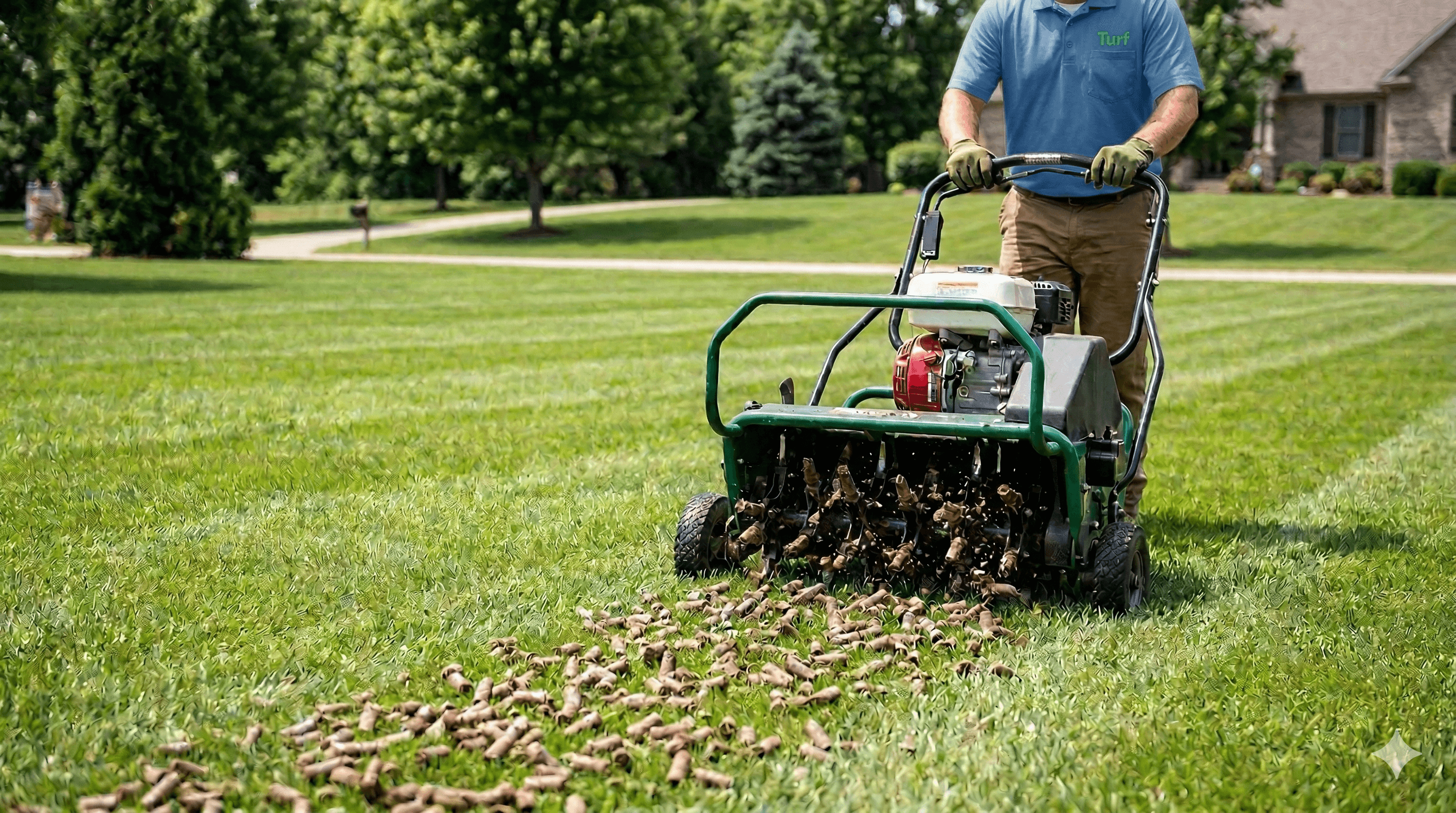
Choose hollow‑tine core aeration every time. Spike tools push clay aside and can make compaction worse—like poking a fork in a baked potato. Core aeration removes plugs, creates real space for air and water, and lets sand or compost settle into the profile.
Aim for:
- Hollow tines ½ inch wide, 2–3 inches deep.
- 2–3 inch spacing in compacted areas (a double pass helps).
- Moist—but not soggy—soil so tines pull clean plugs.
This is also the technique our local rule of thumb favors for relieving compaction while the grass is actively growing.
What should you do after aeration for fastest recovery?
Dial in the first two weeks and the lawn will repay you all summer.
Water
- Give the lawn a light soaking the day after aeration (about ½ inch), then resume your normal schedule. In sandy topdressed spots, check moisture more often for a week.
- Avoid standing water; clay smears when saturated.
Mowing
- Keep your regular cadence. Mowing breaks up cores naturally. For Bermuda and Zoysia, mow at the low end of your normal range to encourage lateral fill.
- Fescue (in fall): maintain your preferred height; don’t scalp.
Nutrients
- Warm‑season lawns respond well to a balanced feeding after aeration. If you’re topdressing with compost, reduce nitrogen accordingly.
- Fescue (in fall): pair aeration with overseeding and a starter fertilizer, then water consistently.
Weed control
- Hold most herbicide applications 7–10 days after aeration unless the product label allows otherwise.
- Expect a few opportunistic weeds near holes; healthy turf will close them quickly.
Topdressing
- On Huntsville clay, a thin ¼ inch of sand or sand‑compost blend after coring pays dividends in drainage and root run. Brush it into holes; don’t bury the grass.
Traffic
- Limit heavy use for 24–48 hours, especially on saturated spots or slopes.
Local rule of thumb recap: in North Alabama’s Zone 7b, aim for ~65°F soil at 2–4 inches—usually late April in Huntsville—then core aerate Bermuda and Zoysia. Our average last frost around March 31 is a reminder: March is still too early here.
Local takeaway: If you’re deciding when to aerate your lawn in Huntsville, wait for full green‑up and warm soil—late April through June for Bermuda and Zoysia—and reserve Tall Fescue aeration for September through October. Hollow‑tine core aeration is the method that relieves clay compaction and sets you up for thick turf with fewer weeds.
That’s the stance we take because it works for Zone 7b and our clay: time aeration with active growth, not with the calendar’s first warm day.
Ready for the right timing, without the guesswork? Get matched with our Huntsville team here: Get a free quote for lawn aeration in Huntsville →